
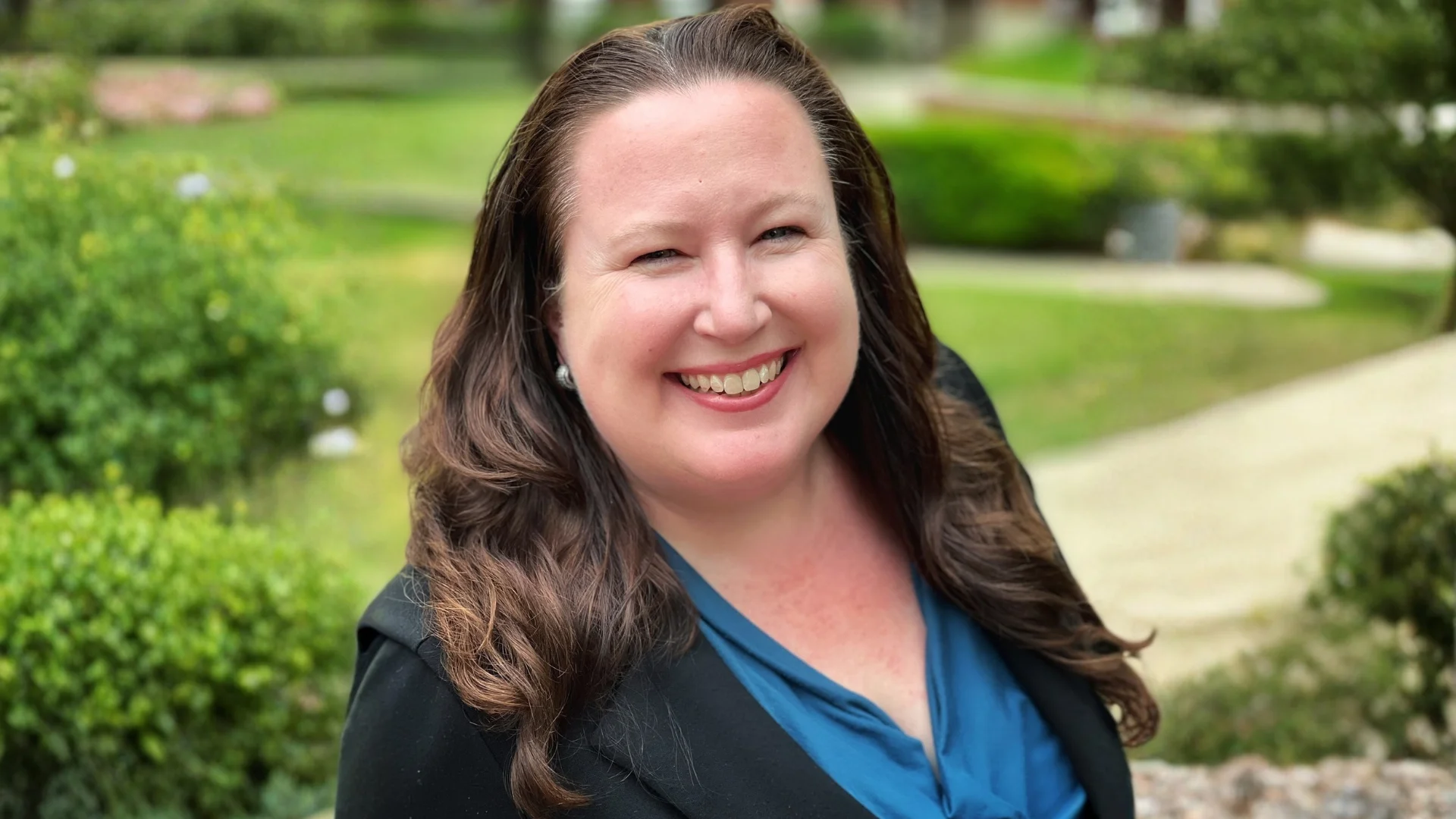
After earning a bachelor’s degree in history from Hendrix College, Margie Alsbrook began her career as a business reporter focusing on the food and agriculture industries. This work led to an interest in the legal aspects of those sectors. She later moved into corporate public relations, where frequent interactions with legal teams influenced her decision to pursue law.
Alsbrook recalled the moment she decided to change careers: “There was a moment in my corporate job when I was running an errand and the car in front of me had a bumper sticker that said, ‘Due to budget cuts, the light at the end of the tunnel has been turned off.’ The company where I was working was having some troubles, and I could tell layoffs were coming. But it was not until that moment that I realized how unhappy I had become in that job. I went back to the office and gave my boss four weeks’ notice, and pretty soon after that I signed up to take the LSAT.”
She noted that she did not fully realize law was a good fit until starting school: “I don’t think I really knew what a great fit it was for me until I was already actively engaged in the study of law,” she said.
Alsbrook received her J.D. from the University of Arkansas School of Law in 2005. During her time there, she contributed as a member of the Arkansas Law Review, served as national student director for an ABA competition, and co-founded the Journal of Food Law & Policy. The journal reached subscribers across six continents by its first publication; Alsbrook also co-authored a special edition sent to every member of Congress.
“We worked hard to create ‘evergreen’ policies that would set the journal up for success for years to come,” Alsbrooke said. “This was vital because law journals have 100% leadership turnover every year, so the structure has to be solid for a journal to succeed. I am very proud that we just celebrated our 20th anniversary this year.”
She later completed an LL.M. with research focused on food safety and labeling issues while working at the National Agricultural Law Center.
Before joining academia full-time, Alsbrook practiced law for nearly twenty years with clients primarily in small business and food/agricultural policy sectors. Her work included genetically modified organism (GMO) regulations related to biotechnology governance.
When asked why she became a professor after establishing her practice, Alsbrook explained: “People had been telling me for a long time I would be a good law professor... It was like a part of my heart that I did not know was there cracked open, and I truly found my purpose. I loved teaching so much I could not imagine not doing it.”
This realization led her to accept a teaching position at Mercer University’s School of Law despite moving far from home: “That was one of the best decisions I have ever made,” she said.
At Mercer Law School, Alsbrook teaches several courses including Civil Lawsuits and Agricultural Law Seminar. She emphasizes communication skills and client advocacy for students.
“Helping students grow in their understanding of the law and change their approach to legal skills over the course of a semester and seeing them continue to increase skills during their time at Mercer Law … it’s truly an honor,” she said. “Mercer Law students are amazing, and working with them is the best part of the job.”
Alsbrook works alongside faculty such as Professor Pat Longan and Dean Karen Sneddon on projects like formalizing partnerships with legal publications. She also advises student groups including Phi Delta Phi and serves on Middle Georgia Justice’s board.
Of campus life at Mercer Law School she stated: “Everyone takes what we do seriously, but we are all here to help the students as much as possible, and that keeps us focused on kindness and pragmatic productivity. It’s a great community and a great learning environment,” she said.
Now living in Middle Georgia, Alsbrook participates in local events connected with Mercer University music programs as well as volunteering activities during her free time.